· Nett
How UK freelancer taxes compare across Europe in 2026
A UK-focused comparison of freelancer taxes across the UK, Spain, Portugal, France, Germany and Italy: Income Tax, VAT, National Insurance, social charges and payment calendars.
Imagine a UK sole trader sends the same six invoices as a freelancer in Spain, Portugal, France, Germany and Italy.
Same work. Same client. Same revenue.
The tax reserve will not look the same.
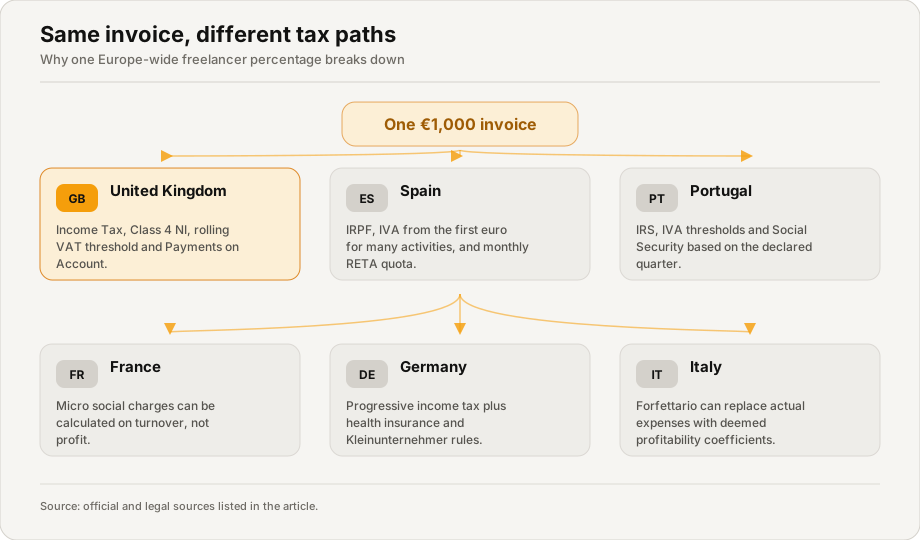
In the UK, you think in Self Assessment, Class 4 National Insurance, Payments on Account and a VAT threshold measured over a rolling 12 months. In Spain, the same freelancer may have to deal with IVA from the first euro. In France, social charges can be a percentage of turnover. In Italy, the forfettario regime can turn the calculation into a deemed-profit model.
“Freelancer tax” sounds like one problem. It is not. It is a local cash-flow problem.
That is why Nett uses country-specific tax rules. A generic “save 30%” estimate is too blunt for real freelance income.
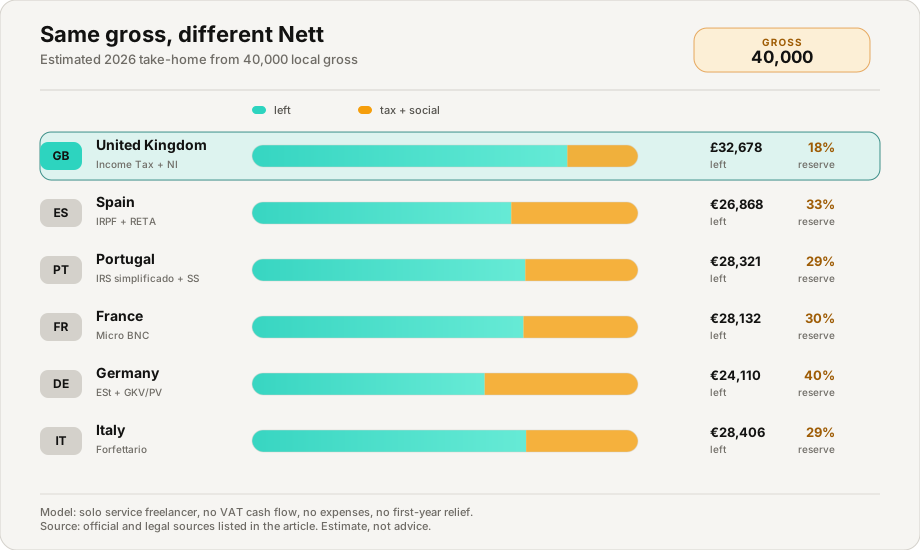
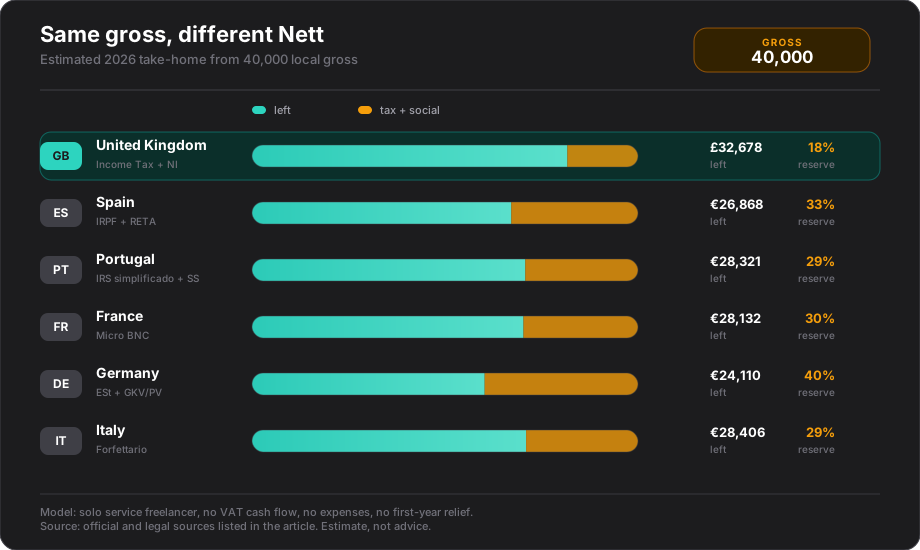
The figures are calculated from official and legal sources. They are listed at the end of the article.
The 2026 comparison
| Country | What tends to matter most | Local trap |
|---|---|---|
| United Kingdom | Income Tax, Class 4 NI, VAT registration and Payments on Account | VAT is measured over a rolling 12 months, not just the tax year |
| Spain | IRPF, IVA and monthly RETA quota | IVA can matter from the first euro |
| Portugal | IRS, IVA and Social Security on deemed revenue | Social Security follows the declared previous quarter |
| France | Micro social charges and VAT franchise thresholds | Contributions can be based on turnover, not profit |
| Germany | Income tax, health insurance and Kleinunternehmer VAT rules | The current-year VAT threshold can be lost immediately |
| Italy | Ordinary IRPEF vs forfettario | Forfettario uses deemed profitability coefficients |
United Kingdom
- Income tax: Progressive Income Tax bands of 0%, 20%, 40% and 45%. Personal Allowance is GBP12,570 and tapers above GBP100,000.
- VAT: Standard VAT is 20%, with 5% reduced and zero-rated cases. Registration threshold is GBP90,000 over a rolling 12-month period.
- Contributions: Class 4 NI is 6% on profits from GBP12,570 to GBP50,270, then 2%. Class 2 is GBP3.65/week and voluntary in Nett’s 2026 rules.
- Simplification: No freelancer flat-tax regime in Nett’s UK model. The main simplification is staying below VAT registration.
- Payments: Self Assessment is due 31 January. Payments on Account fall on 31 January and 31 July. VAT returns are quarterly if registered.
Spain
- Income tax: Progressive IRPF bands of 19%, 24%, 30%, 37%, 45% and 47%. Modelo 130 uses a 20% cumulative quarterly method.
- VAT: Standard IVA is 21%, with 10% reduced and 4% super-reduced rates. Nett’s 2026 rules do not include a general VAT exemption threshold for Spain.
- Contributions: RETA is a fixed monthly quota based on net monthly income: EUR205.88 to EUR607.35/month.
- Simplification: No micro flat-tax regime is encoded. Tarifa plana is social-security relief, not a tax regime.
- Payments: RETA monthly. Modelo 130 and Modelo 303 quarterly. Modelo 100 and Modelo 390 annually.
Portugal
- Income tax: IRS bands run from 12.5% to 48%. Simplified Category B uses a 75% profit coefficient.
- VAT: Standard IVA is 23%. Article 53 exemption applies up to EUR15,000 previous-year revenue, with a EUR18,750 current-year override.
- Contributions: Social Security is 21.4% on 70% of gross revenue, effectively about 15% of gross revenue.
- Simplification: Simplified Category B treatment uses deemed profit.
- Payments: Social Security is declared quarterly and paid monthly. IVA is quarterly, or monthly above EUR650,000 previous-year turnover.
France
- Income tax: Progressive bands of 0%, 11%, 30%, 41% and 45%. Micro-entrepreneurs may use versement liberatoire rates of 1%, 1.7% or 2.2%.
- VAT: Standard TVA is 20%. Franchise en base thresholds are EUR37,500 for services and EUR85,000 for goods.
- Contributions: Micro social charges are based on turnover: 25.6% liberal services, 23.2% CIPAV, 21.2% commercial services and 12.3% goods.
- Simplification: Micro-entrepreneur regime uses abatements of 34%, 50% or 71% depending on activity.
- Payments: URSSAF can be monthly or quarterly. Income tax has an annual return. VAT only applies above thresholds.
Germany
- Income tax: Progressive Einkommensteuer with a 2026 allowance of EUR12,348, formula-based middle zones, then 42% and 45% top rates.
- VAT: Standard Umsatzsteuer is 19%. Kleinunternehmer applies up to EUR25,000 previous-year and EUR100,000 current-year revenue.
- Contributions: Mandatory health insurance is 14.6% plus about 2.9% Zusatzbeitrag. Care insurance is 4.2% without children or 3.6% with children. Pension is often voluntary for Freiberufler.
- Simplification: Kleinunternehmer simplifies VAT, not income tax.
- Payments: Quarterly Vorauszahlungen. VAT Voranmeldung monthly or quarterly. Annual return due 31 July, or 28 February with an advisor.
Italy
- Income tax: Ordinary IRPEF bands are 23%, 33% and 43%. Forfettario uses 15%, or 5% for the first five years if eligible.
- VAT: Standard IVA is 22%. Forfettario is VAT-exempt up to EUR85,000, with immediate exit at EUR100,000.
- Contributions: Gestione Separata INPS is 26.07% on taxable income. Forfettario may reduce INPS by 35% for the first 36 months.
- Simplification: Regime forfettario uses profitability coefficients by activity, such as 67%, 78%, 40%, 62% or 86%.
- Payments: Modello Redditi PF is annual. IRPEF/INPS acconti are usually 40% in June and 60% in November.
Why the UK feels different
The UK calculation looks familiar because most sole traders hear about the same few ideas: Income Tax, National Insurance, VAT and Self Assessment.
The awkward bit is the timing.
Income Tax uses progressive bands. In Nett’s 2026/27 rules, the Personal Allowance is GBP12,570, then profit moves through 20%, 40% and 45% bands. Crossing into a higher band does not mean all your profit gets taxed at that rate. Each slice is treated separately.
National Insurance is separate. Nett’s UK model includes Class 4 NI at 6% from GBP12,570 to GBP50,270, then 2% above that. Class 2 is listed as GBP3.65/week and voluntary in the 2026/27 rules.
VAT is separate again. The registration threshold is GBP90,000, but not by calendar year. It is tested over a rolling 12 months. A strong stretch from September to the following August can matter even if neither calendar year looks dramatic on its own.
Then there is the payment calendar. Self Assessment is due on 31 January. Payments on Account can add another bill on 31 January and 31 July, based on the previous year’s tax. That is why January can feel wrong even when the tax calculation itself is right.
What this means for cross-border freelancers
If you are based in the UK and invoice European clients, another country’s headline rate will not tell you much about your own cash flow.
Spain’s 21% IVA is not the same kind of problem as UK VAT registration. France’s micro social charges are not the same as UK Class 4 NI. Italy’s forfettario is not a normal progressive income-tax calculation. Germany’s health insurance can be a major monthly cash-flow item even before income-tax settlement.
The same invoice can create different reserves depending on where the freelancer is resident, which regime applies and when the next payment is due.
That is why Nett does not use one Europe-wide freelancer percentage.
Nett’s approach
Nett estimates what is actually yours country by country.
For UK freelancers, that means separating Income Tax, Class 4 National Insurance, VAT if registered, the 6 April to 5 April tax year, and cash-flow warnings for Payments on Account.
It does not file your Self Assessment. It does not replace your accountant. It gives you a working number for the question that matters between tax deadlines:
After the tax money is set aside, what can I safely spend?
Download Nett on the App Store.
This article is an estimate-based guide, not tax advice.
Sources
Official and legal sources used for the article figures:
- United Kingdom: GOV.UK - Rates and thresholds for employers 2026 to 2027, GOV.UK - Making Tax Digital for Income Tax
- Spain: Ley 37/1992 del IVA, Agencia Tributaria - Tipos IVA, RD 439/2007 Reglamento IRPF, Simulador RETA de la Seguridad Social
- Portugal: Art. 68 CIRS, Art. 25 CIRS, DGAEP - Valores do IAS
- France: service-public.gouv.fr - Barème de l’impôt sur le revenu, economie.gouv.fr - Micro-enterprise social contributions
- Germany: § 19 UStG, § 13b UStG, § 32a EStG
- Italy: Agenzia Entrate - Regime forfettario requisiti, INPS - Gestione Separata aliquote 2026, Agenzia Entrate - IRPEF scaglioni e aliquote 2026