Payment on account: why HMRC wants more tax by 31 July
What a payment on account is, why the number is based on a year you have already finished, and the two traps that catch freelancers: reducing it too far, and the January cliff.
On 31 July, HMRC wants money from you for tax you haven’t been billed for yet.
That’s what a payment on account is, and it’s why it feels so unfair. You did your return, you paid in January, and now there’s a second bill with no obvious explanation attached.
Here’s what the number actually is, where it comes from, and the two traps that catch people.
What it is
A payment on account is an advance on next year’s tax bill. HMRC asks for it in two instalments: one on 31 January, one on 31 July.
Each instalment is half of last year’s tax bill. That is the whole calculation.
It covers your income tax and your Class 4 National Insurance. It does not cover Class 2 NI, student loan repayments or capital gains tax. Those three wait for January.
Why the number feels wrong
Because it isn’t based on this year. It’s based on last year.
HMRC has no idea what you earned this year. So it assumes you earned the same as last year, and asks for half of that bill up front, twice.
For someone on a steady salary that assumption is roughly fine. For a freelancer with irregular income it’s wrong almost by definition. A great year followed by a quiet one, and you’re prepaying tax on money you never made.
That’s the part nobody explains. The July bill isn’t a calculation about you. It’s a guess based on the person you were last year.
Who doesn’t have to pay it
Two ways out, and you only need one:
- Your last tax bill was under £1,000, or
- More than 80% of your tax was already collected at source, through PAYE or your tax code.
If either is true, no payments on account. You just pay the whole thing in January.
Trap 1: reducing it too far
You can ask HMRC to reduce your payments on account if you know this year is going to be smaller. Through your online account, or with form SA303.
This is the right move when your income really has dropped. It is also where people get burned.
If you reduce the payment below what you actually end up owing, HMRC charges interest on the difference, backdated to the original due dates. Not from the day you found out. From January and July, as if you had underpaid all along.
The current late payment rate is 7.75%. It moves with the Bank of England base rate, and it has changed four times in the last twelve months, so check it before you rely on it.
Reduce it because you have done the maths. Not because the number is uncomfortable.
Trap 2: “there’s no penalty in July”
This one is technically true and dangerously incomplete.
Miss the 31 July payment and there’s no automatic late payment penalty. The 5% penalties that apply at 30 days, 6 months and 12 months don’t apply to payments on account. Interest runs, but no fine.
So people relax. And that’s the mistake.
Because if that payment is still outstanding on 31 January, it stops being a payment on account. It gets rolled into your balancing payment, and the balancing payment does carry the 5% penalties.
The penalty isn’t cancelled. It’s postponed.
The January cliff
Here’s why January hurts so much more than July, with numbers.
Say last year’s bill was £6,000. Your payments on account are £3,000 each.
| Date | What you pay | |
|---|---|---|
| 31 Jan 2026 | First payment on account | £3,000 |
| 31 Jul 2026 | Second payment on account | £3,000 |
Now suppose you had a better year, and your actual bill comes in at £8,000.
| Date | What you pay | |
|---|---|---|
| 31 Jan 2027 | Balancing payment (£8,000 − £6,000) | £2,000 |
| 31 Jan 2027 | First payment on account for next year (half of £8,000) | £4,000 |
| Total due in January | £6,000 |
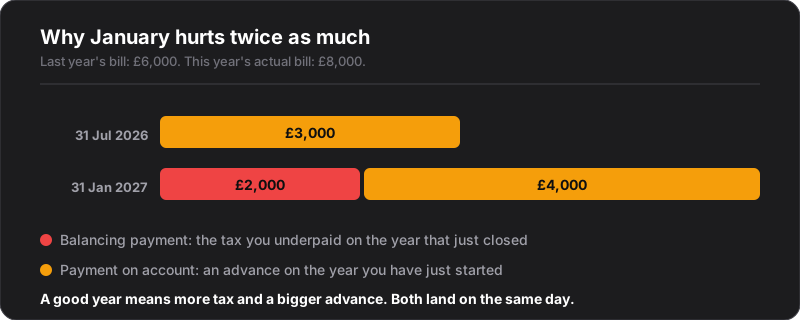
You paid £3,000 in July and £6,000 in January. Same tax year, double the bill, because January stacks the shortfall from the year you finished on top of the advance for the year you just started.
A good year does not just mean more tax. It means more tax and a bigger advance, both landing on the same day.
If you can’t pay by 31 July
Set up a Time to Pay plan. You can do it yourself online, without phoning anyone, if:
- you have filed your latest return,
- you owe £30,000 or less,
- you are within 60 days of the due date, and
- you can clear it within 12 months.
Above £30,000, or if you need longer, you have to call the Self Assessment Payment Helpline.
Interest still runs during the plan. But a plan is far cheaper than silence.
Worth checking with your accountant
This article simplifies on purpose. Things that change your case:
- Whether you are in Scotland, where income tax bands are different.
- Class 2 NI and student loan repayments, which sit outside the payments on account but land in January.
- Whether a reduction claim is justified in your specific situation.
The point of this post is that you understand what you are paying and why, not that you file it blind.
How Nett gives you this number before July arrives
The problem with payment on account isn’t the arithmetic. It’s that HMRC is guessing your income from last year, and you have no counter-number of your own.
Nett tracks what you’ve actually earned and spent this year, and shows you what’s genuinely yours after tax is set aside. So when the July bill lands you already know two things: what HMRC is asking for, and what your real year looks like.
That’s the difference between reducing a payment on account because you have the numbers, and reducing it because it hurts.
It’s an estimate, not an HMRC calculation. But turning up on 31 July already knowing the number beats finding out on the day.
Related articles
The £1,000 trading allowance: when your side hustle is tax-free (and when it isn't)
The trading allowance can cover up to £1,000 of side income without tax or a Self Assessment return. But it's £1,000 of sales, not profit, and that detail catches people every year.
Selling on Vinted or eBay: When You Must Register as Self-Employed (UK, 2026)
HMRC now gets your sales data from Vinted, eBay and Depop. Here's when that actually means tax, when it doesn't, and when you need to register. UK, 2026.
How UK freelancer taxes compare across Europe in 2026
A UK-focused comparison of freelancer taxes across the UK, Spain, Portugal, France, Germany and Italy: Income Tax, VAT, National Insurance, social charges and payment calendars.