The £1,000 trading allowance: when your side hustle is tax-free (and when it isn't)
The trading allowance can cover up to £1,000 of side income without tax or a Self Assessment return. But it's £1,000 of sales, not profit, and that detail catches people every year.
At some point every side hustle hits the same moment. You’ve sold a few prints, done some freelance jobs on the side, walked some dogs. Money is coming in, not much, but real. And somewhere in the back of your head a question starts nagging: am I supposed to be telling HMRC about this?
The answer, for a lot of people, is no. That’s what the trading allowance is for. But the rule has a sharp edge that catches people every year, so here it is properly.
The rule in one sentence
If your total trading income is £1,000 or less in a tax year (6 April to 5 April), you generally don’t owe tax on it and don’t need to register or file a Self Assessment return for that income alone.
That’s the trading allowance. It exists so HMRC doesn’t have to process a tax return for every person who sold £300 of crochet on Etsy.
It covers self-employment income, casual services like gardening or babysitting, and money from hiring out your equipment. All your trades combined, not £1,000 each.
The sharp edge: it’s £1,000 of sales, not profit
This is the part people get wrong.
The allowance applies to your gross income. What came in. Not what was left after costs.
Say you sold £1,200 of prints and spent £400 on materials and postage. Your profit is £800, which feels like it should be under the limit. It isn’t. Your gross income is £1,200, you’re over the allowance, and you need to register for Self Assessment and report the income.
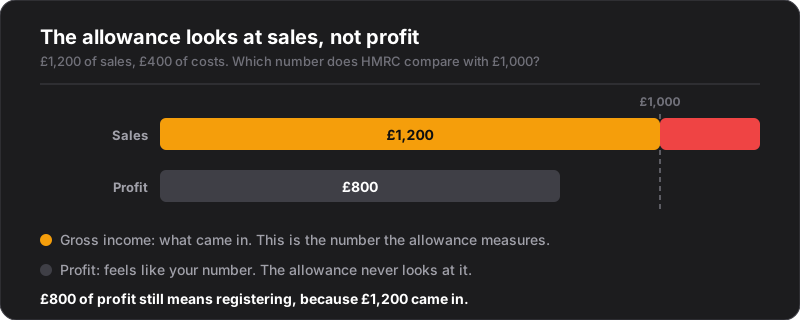
If you’ve been tracking your side income by profit, check the sales figure before you assume you’re fine.
Over £1,000: you get a choice
Once you’re past the allowance, you don’t lose it. It turns into a choice.
When you work out your taxable profit, you can deduct either your actual expenses or a flat £1,000. Never both.
Two examples, same £4,000 of income:
- Expenses of £600 → claim the allowance instead. Taxable profit £3,000 rather than £3,400, and you don’t need a single receipt.
- Expenses of £1,800 → claim the real expenses. Taxable profit £2,200.
The rule of thumb writes itself: expenses under £1,000, take the allowance; over £1,000, deduct the real thing. You can switch from one year to the next, so a cheap year and an expensive year can each get the better treatment.
If you’re deducting real expenses, what actually counts as an allowable expense is its own topic.
When you have to register
If your gross trading income goes over £1,000, you need to register for Self Assessment by 5 October after the end of the tax year you crossed it in. Go over the line in 2026/27 and you have until 5 October 2027.
There are also cases where registering is worth it even under £1,000: you made a loss you want to claim relief for, or you want to pay voluntary Class 2 National Insurance to protect your State Pension record.
About that “£3,000 threshold” you’ve seen in headlines
You may have read that the side hustle threshold is going up to £3,000. Half true, and the half that’s false is expensive.
From the 2027/28 tax year, HMRC plans to raise the reporting threshold for trading income to £3,000. People earning between £1,000 and £3,000 will use a simpler online service instead of a full Self Assessment return.
What is not changing: the tax. The tax-free allowance stays at £1,000. Earn £2,500 in 2027/28 and you’ll have less paperwork, but you’ll still owe tax on the income above the allowance.
Less form is not less tax. Worth keeping those two ideas separate before the headlines merge them for you.
HMRC probably already knows
If your side income comes through Vinted, Etsy, eBay, Airbnb or another reportable platform, the platform may report your details and sales data to HMRC when you reach the relevant reporting threshold — generally 30 or more activities, or about €2,000 in a year. That’s been running since January 2024.
So “it’s small, nobody will notice” is not a strategy. Platform reports give HMRC another way to check the figures against what you declare.
The flip side matters too: selling your own old clothes and clutter usually isn’t trading at all, so no tax regardless of the amount. We wrote about where that line actually sits if you mostly sell second-hand.
Where the allowance doesn’t work
A few cases where you can’t use it, even under £1,000: income from your own company, from a partnership you’re in, or from your employer (or your spouse’s). The allowance is for genuine side income, not for rerouting money you’d otherwise be taxed on.
If any of that sounds like your setup, or your side income is heading towards real money, this is the point where an accountant earns their fee. This article simplifies on purpose.
The question the allowance doesn’t answer
The trading allowance tells you whether HMRC needs to hear from you. It doesn’t tell you the thing you actually want to know once you’re past £1,000: how much of this money is mine?
That’s the question Nett answers. It tracks what your side income actually brings in, sets aside an estimate for tax as you go, and shows you what’s genuinely yours to spend. So the number doesn’t ambush you in January, and “I’ll deal with tax later” stops being the plan.
It’s an estimate, not a filing. But knowing what’s yours while the year is still happening beats finding out after it’s over.
Related articles
Payment on account: why HMRC wants more tax by 31 July
What a payment on account is, why the number is based on a year you have already finished, and the two traps that catch freelancers: reducing it too far, and the January cliff.
Selling on Vinted or eBay: When You Must Register as Self-Employed (UK, 2026)
HMRC now gets your sales data from Vinted, eBay and Depop. Here's when that actually means tax, when it doesn't, and when you need to register. UK, 2026.
How UK freelancer taxes compare across Europe in 2026
A UK-focused comparison of freelancer taxes across the UK, Spain, Portugal, France, Germany and Italy: Income Tax, VAT, National Insurance, social charges and payment calendars.